

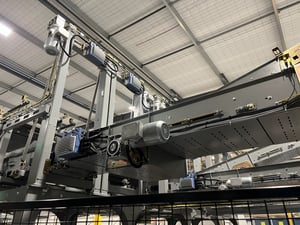
Ask ten people what "warehouse automation" means and you'll get ten different answers. Some picture a fully lights-out facility with robots doing everything. Others think it just means a few motors added to existing conveyor lines. Neither is wrong exactly, but neither is the full picture either.
Automation isn't a single piece of equipment you buy. It's a set of systems that need to talk to each other and move product in the same direction, physically and informationally. For distribution centres and 3PLs, understanding how these pieces fit together matters more than understanding any one piece in isolation
What Counts as Warehouse Automation
At its simplest, warehouse automation is any system that moves, stores, sorts, or processes product with reduced manual handling. That's a broad definition on purpose, because the term covers a wide range of technology, from a single motorised conveyor section through to a fully integrated facility running AS/RS, AGVs, and robotic palletisers under one control system.
The common thread across all of it is flow. Every automated system in a warehouse exists to move product from one point to another with less handling, less variability, and less time lost. Conveyors are usually the connective tissue that makes that flow physically possible.
How the Core Systems Fit Together
Each of these systems does a different job, but none of them works in isolation. Conveyor is usually what ties them together, physically moving product between the points where storage, transport, and palletising each take over.
How Conveyors Connect the Rest of the System
It's easy to think of conveyors as the least sophisticated part of an automated warehouse, especially next to something like a robotic palletiser. In practice, conveyors are what everything else connects to.
An AS/RS needs product delivered to and retrieved from specific pick faces. An AGV needs a handoff point where it can pick up or drop a load without a forklift standing by. A robotic palletiser needs product presented in a consistent orientation, at a consistent rate, or it can't do its job properly. Conveyor systems handle those transitions. They set the pace, manage accumulation, and keep product moving predictably between systems that otherwise wouldn't be able to interact.
This is why conveyor design decisions, line speed, buffering capacity, divert logic, have a direct effect on how well the rest of an automated system performs. A palletiser can only run as well as the line feeding it.
Where AS/RS Fits In
Automated Storage and Retrieval Systems handle the storage side of the equation. Instead of forklifts or reach trucks moving pallets or cartons to fixed locations, an AS/RS uses cranes, shuttles, or robotic carriers to store and retrieve product within a dense storage structure.
The case for AS/RS usually comes down to two things: floor space and throughput consistency. Vertical storage density reduces the warehouse footprint needed per pallet or carton position, and retrieval times stay consistent regardless of how busy the facility is, which isn't always true with manual picking.
The integration point with conveyors is the induction and extraction interface, the sections where product enters and leaves the AS/RS. Getting that interface right, in terms of speed matching and buffering, is often what separates a system that runs smoothly from one that creates a bottleneck at the exact point where you were trying to remove one.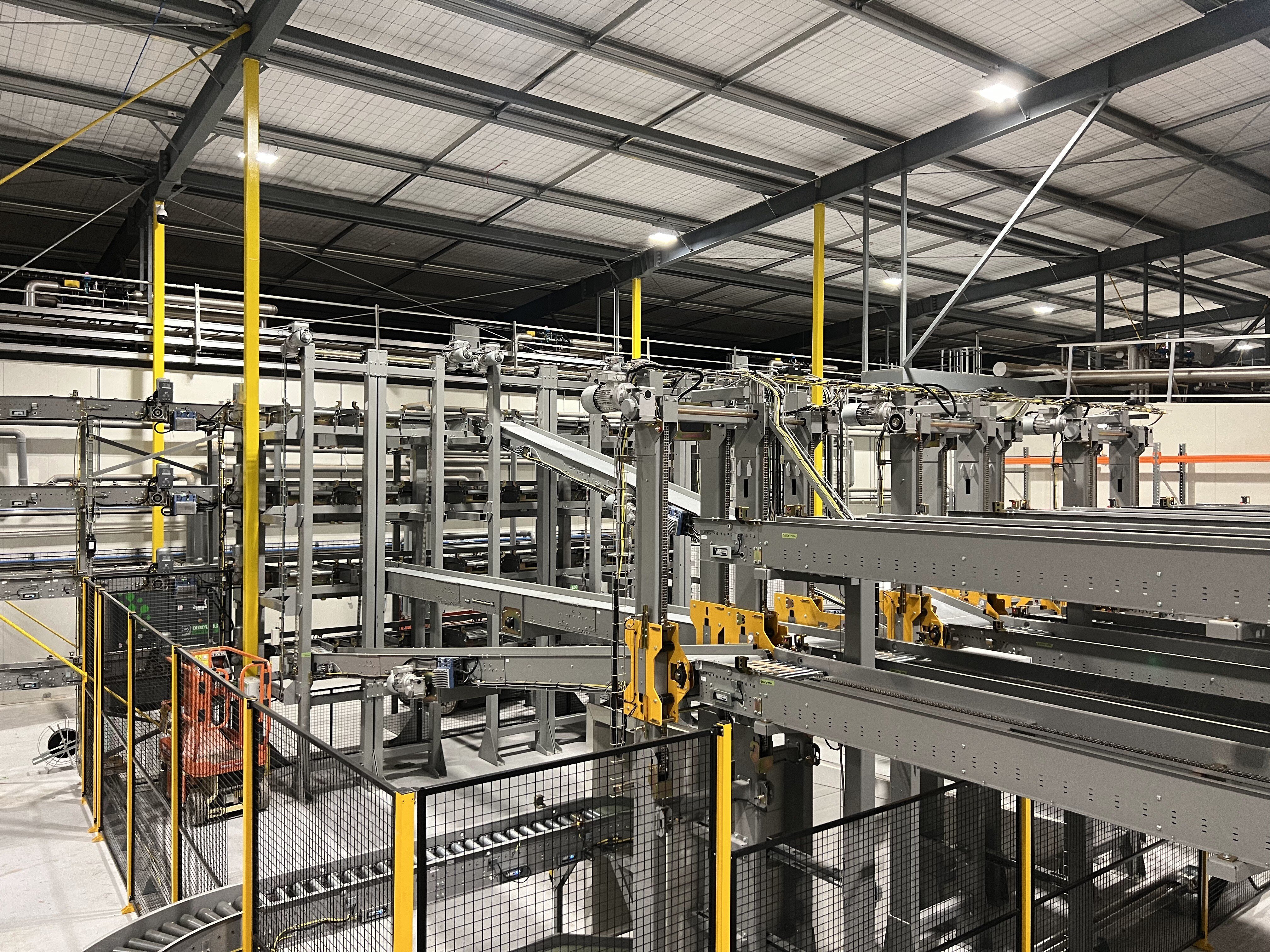
Where AGVs Fits In
Automated Guided Vehicles move product horizontally across a facility, typically pallets or bulk loads, without a fixed track. They navigate using floor sensors, magnetic strips, or increasingly, vision and mapping systems.
AGVs are usually the right call when product needs to move between areas that aren't practical to connect with fixed conveyor, long distances, variable routes, or areas that need to stay flexible for future layout changes. Conveyor is generally the cheaper and more reliable option for fixed, high-frequency paths. AGVs earn their cost where flexibility matters more than raw throughput.
The two systems usually meet at a transfer station, a defined point where a conveyor line hands product to an AGV or the reverse. As with AS/RS, the interface is where problems show up if it's not designed properly. Timing, orientation, and load stability all need to be right at that handoff.
Where Robotic Palletisers Fits In
Robotic palletisers build pallets automatically, stacking cartons or cases in a defined pattern based on product dimensions, weight, and stability requirements. They sit at the end of a production or packing line, usually right where conveyor delivers finished product for palletising.
The palletiser's performance is entirely dependent on what it's fed. Inconsistent spacing, incorrect orientation, or variable product presentation will slow a robotic palletiser down or force it into error handling more often than it should. This is one of the clearest examples of why automation projects succeed or fail based on integration, not just equipment specification. A capable palletiser paired with a poorly designed infeed conveyor won't perform to its rated capacity.
Why Integration Is the Hard Part
Buying an AS/RS, a fleet of AGVs, and a robotic palletiser doesn't automatically give you an automated warehouse. Each system has its own control logic, its own communication protocol, and its own operating assumptions. Getting them to function as one coherent system, rather than three separate systems that happen to sit in the same building, is where most of the engineering effort actually goes.
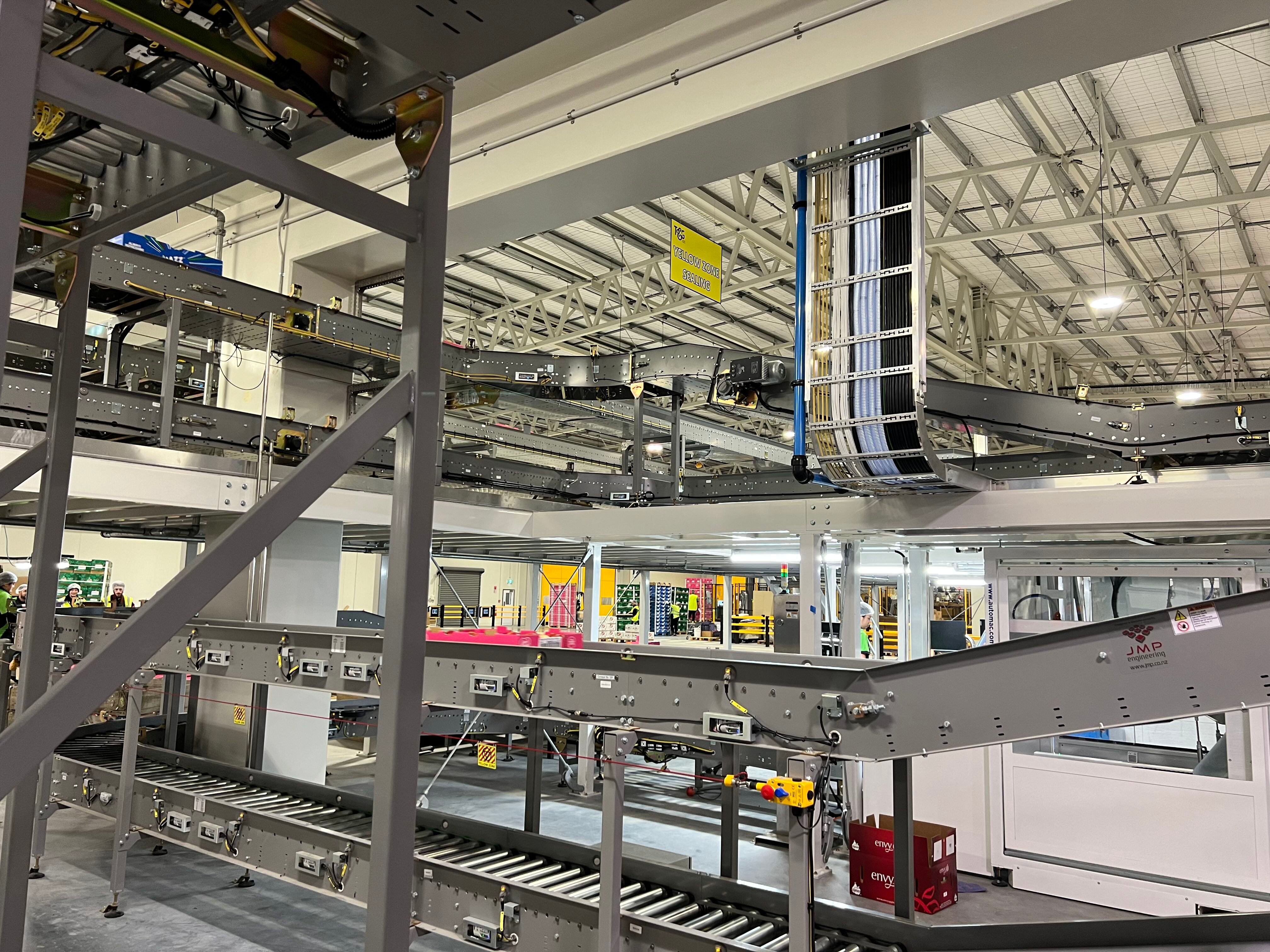
Conveyor systems play a specific role here beyond just moving product. They're often the layer that absorbs timing mismatches between systems running at different speeds, provides buffering so one slow system doesn't stall everything upstream, and gives you physical flexibility to adjust flow paths without redesigning the whole facility.
This is also where a lot of automation projects run into trouble. It's common for each system to be specified and quoted separately, by different vendors, without anyone taking full responsibility for how they'll work together on day one. The conveyor and controls layer is usually where those gaps get exposed, because it's the part that has to interface with everything else.
What This Means for Distribution Centres and 3PLs
For DCs and 3PLs, the practical question is rarely "should we automate." It's which parts of the operation justify automation, and in what order.
High-volume, repetitive flows with consistent product characteristics are usually the best starting point, sortation, palletising, and induction into storage systems. Highly variable product mixes, especially with irregular packaging or unpredictable order profiles, are harder to automate cost-effectively and often need a hybrid approach, at least initially.
The sequencing matters too. Getting conveyor and control logic right first gives you a foundation that AS/RS, AGVs, or robotics can be added to later, rather than requiring a rebuild every time a new system is introduced.
Where to Start
If you're assessing automation for your facility, the equipment list is the easy part. The harder questions are about flow: where product moves, how fast, where it buffers, and how each system will hand off to the next.
MCL designs and manufactures the conveyor systems that connect automated equipment into one working line, and integrates with AS/RS, AGV, and robotic palletising solutions as part of broader automation projects. If you're mapping out what automation could look like for your operation, get in touch or take a look at our warehouse automation page.