

.png?width=300&name=MCL%20-%20Header%20Image%20(1).png)
Motor-driven roller conveyors are one of the most talked-about technologies in food manufacturing and packhouse automation right now. They are also one of the most frequently over-specified — and just as often, under-specified — by buyers who do not fully understand what they are buying.
This post is a straightforward decision guide. No sales pitch. Just a clear explanation of what MDR conveyors are, when they are the right choice, when they are not, and what the common misconceptions are that lead to expensive mistakes.
If you are an operations manager, plant engineer, or decision-maker evaluating conveyor options for your facility — this is worth reading before you finalise any specification.
What is a Motor-Driven Roller Conveyor
A motor-driven roller (MDR) conveyor — sometimes called a 24V DC roller conveyor or zero-pressure accumulation conveyor — uses individual motorised rollers rather than a single centralised drive system.
In a traditional powered roller conveyor, one motor drives a belt, chain, or band that turns every roller on the conveyor simultaneously. The whole line either moves or it does not.
In an MDR system, each roller (or small group of rollers) has its own small DC motor built directly into the roller body. Each section — called a zone — can be controlled independently. A zone can run, stop, accelerate, or decelerate without affecting any other zone on the same conveyor.
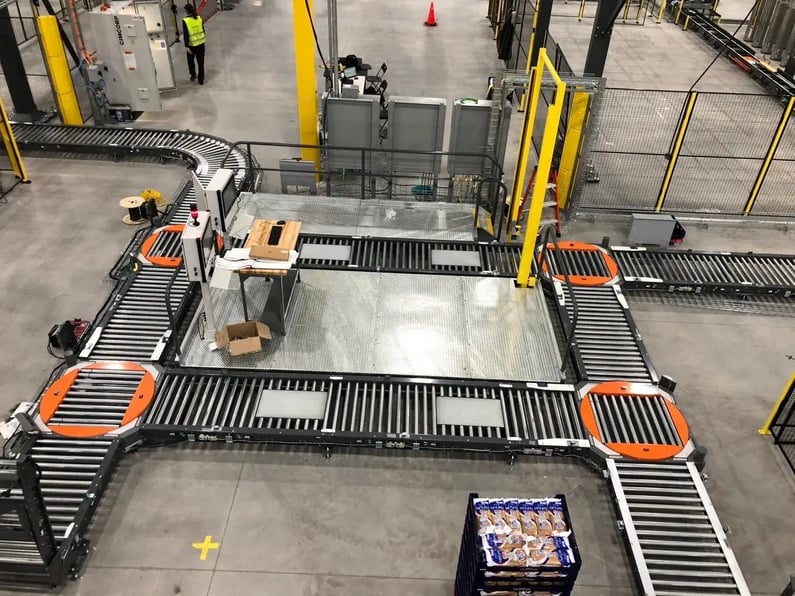
Image: MCL Roller Conveyor System
What MDR Conveyors Do Well
The zone-by-zone control that MDR provides solves a specific set of problems that traditional conveyor drives cannot address effectively.
ZERO-PRESSURE ACCUMULATION
In a traditional accumulation conveyor, product builds up against the product in front of it — creating back pressure. For packaged food, this means compression damage, label scuffing, and seal failures.
MDR conveyors hold each item in its own zone and stop the zone without stopping the product upstream. Items queue without touching. When the downstream process is ready, zones release one at a time. No pressure. No damage.
For kiwifruit in packaged trays, or for finished food products moving toward a labeller or check weigher, this is a significant quality benefit.
ENERGY EFFICIENCY
24V DC motors are significantly quieter than AC-driven conveyor systems. For operations in food manufacturing facilities where noise levels affect both worker safety and regulatory compliance, this is a real operational benefit.
QUIET OPERATION
A traditional line-shaft or belt-driven roller conveyor runs its motor continuously, whether product is present or not.
MDR zones only activate when product enters them. On a conveyor that is 60% loaded during normal operation, the energy saving is substantial — and the reduction in motor wear translates directly to longer service life and less maintenance.
FLEXIBLE PRODUCT SPACING AND SORTATION
When products need to arrive at a specific point with consistent spacing — before a labeller, check weigher, or robotic pick station — MDR zones give you precise control over that spacing without additional hardware.
Products can also be merged, diverted, and accumulated across multiple lanes with a level of precision that traditional conveyor drives cannot replicate.
When MDR Is The Right Choice
When MDR Is Not The Right Choice
This is the part of the conversation that does not always get discussed — but it is just as important.
Use MDR When
-
Products are packaged, cartonised, or trayed
-
Zero-pressure accumulation is needed
-
You are automating or integrating with control systems
-
Mixed product sizes require flexibility
-
Energy savings justify the investment
Consider alternatives When
-
Products are loose, wet, or irregularly shaped
-
Very high-speed applications (belt conveyors often better)
-
Budget is a hard constraint (MDR costs more upfront)
-
Simple point-to-point transport with no accumulation need
-
Extreme washdown environments without sealed motors
MDR conveyors require flat-bottomed, rigid product to operate correctly. Loose fruit, soft pouches, or any product that does not present a consistent base to the rollers will not run reliably on an MDR system — a belt conveyor will handle that application far better.
Very high-speed applications — where product needs to travel quickly over long distances — are also better served by traditional belt or line-shaft roller conveyors. MDR systems are optimised for control, not raw speed.
And on a straight budget basis: MDR systems carry a higher upfront cost than traditional powered roller conveyor. For simple transport applications with no accumulation or control requirements, that premium does not always deliver a justified return.
Common Misconceptions About MDR
Myth
"MDR conveyors are harder to maintain because of all the individual motors."
Reality
Individual zone motors are easier to replace than a centralised drive system. A failed zone motor can be swapped in minutes. A failed centralised drive takes your entire line down while you wait for parts and a mechanic.
Myth
"MDR is always the best option for food manufacturing."
Reality
MDR is the right answer for specific applications. For simple transport between two fixed points with no accumulation need, a traditional belt or roller conveyor is often more cost-effective and equally reliable.
Myth
"All MDR conveyors are the same."
Reality
Motor quality, zone length, control interface, and integration capability vary significantly between manufacturers. The design of the zone layout — matched to your product and throughput — makes more difference than the brand of motor inside the roller.
Myth
"MDR is only for high-tech warehouses and e-commerce."
Reality
MDR is increasingly common in food manufacturing and kiwifruit packhouses — anywhere that packaged product needs gentle accumulation, precise spacing, or integration with downstream automation.
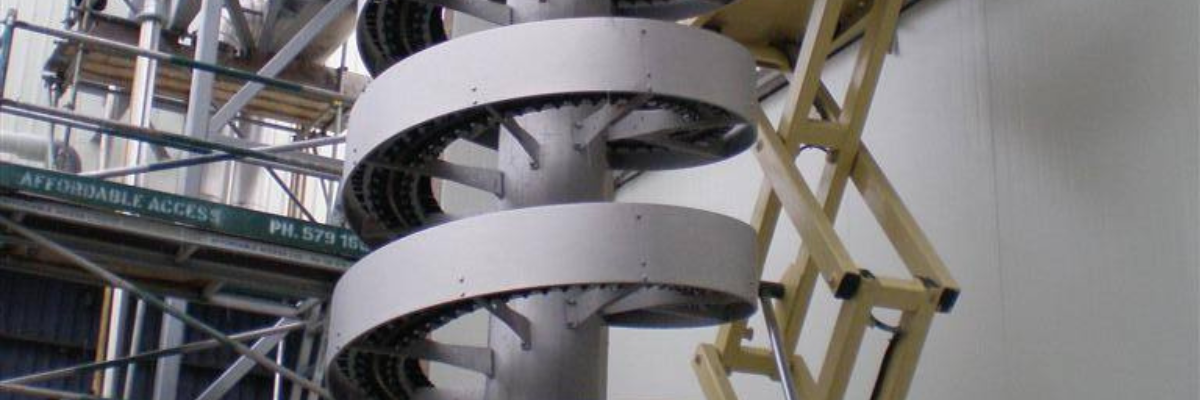
Image: MCL Apollo VTS Spiral Conveyor: MDR Roller sections are frequently integrated with vertical transport systems like the Apollo VTS spiral conveyor, creating seamless multi-level automated lines in packhouses and food factories.
How To Make The Right Decision For Your Faculty
The decision between MDR and traditional conveyor types is not about technology preference. It is about matching the right tool to the specific job in your specific operation.
The most useful conversation you can have before specifying any conveyor system is one that starts with your operation — not with a product catalogue. These are the questions that shape the right answer:
"The best conveyor decision is the one made with full knowledge of the operation — not the one made based on what the supplier had in stock."
The Takeaway
Motor-driven roller conveyors are a genuinely powerful technology when deployed in the right application. Zero-pressure accumulation, energy efficiency, quiet operation, and precision product spacing are real benefits that make a measurable difference in food manufacturing and post-grading environments.
But MDR is not always the answer. Knowing when to specify it — and when a belt conveyor, traditional roller, or gravity system will perform better for less money — is the mark of a system that has been properly designed rather than simply specified.
At MCL, we design systems around your operation. That means recommending MDR where it adds real value — and recommending something simpler when it does not. Because the right system is the one that works best for you, not the most technically impressive option on paper.